
The eMudhra CA Compromise: Why Your JVM Is Vulnerable (and How to Fix It Properly)
Addendum (October 23, 2026): The list of SHA-256 fingerprints in this article has been updated from 16 to 48 hashes. In addition to the 16 canonical certificate fingerprints, the updated list includes the 32 alternate DER and malleable ECDSA signature encodings generated by OpenJDK’s BlockedCertsConverter (as shipped in the official OpenJDK CVE-2026-91403 advisory). If you already applied the initial 16 hashes, please update your blocked.certs file with the full 48-hash list below, or upgrade to the newly released patched JDKs (27.0.1.0.2, 25.0.5.0.2, 21.0.13.0.2, 17.0.21.0.2, 11.0.33.0.2, 8u511).
Crafting a Devoxx Conference Schedule with Gemini, LangChain4j, and Micronaut
With Devoxx Belgium 2026 just around the corner (October 5–9 at Kinepolis Antwerp), I started looking through the schedule to decide which sessions to attend.
With more than 200 talks spread across 5 days, multiple session formats (Deep Dives, Hands-on Labs, Conference sessions, Tools-in-Action, and BOFs), and up to 8 parallel tracks running at any given time, putting together a cohesive, conflict-free agenda by hand takes quite a bit of clicking back and forth.
Read more...Multimodal Decision Models: From DiffusionGemma and Jev to LangChain4j
Most of our conversations around Large Language Models focus on generative chat: you give the model a prompt, and it outputs a sequence of tokens autoregressively.
Recently, Typesafe AI introduced a different paradigm called System 1 models, embodied by Jev. Rather than generating free-form prose token by token, a Jev-style model acts as a high-speed, deterministic decision maker. Given an input state and a series of discrete questions, it runs in a single forward pass and outputs calibrated probability distributions for each question:
Read more...Gemini 3.8 Flash TTS, Voice Design, and Custom Voices with the Gemini Interactions Java SDK
Google recently introduced dedicated text-to-speech models in the Gemini family: Gemini 3.8 Flash TTS (gemini-3.8-flash-tts) and Gemini 3.8 Flash-Lite TTS (gemini-3.8-flash-lite-tts).
The Google team shared the details in their announcement: Gemini 3.8 Text-to-Speech.
To support these new models and their voice customization features in Java, I have published version 2.0.2 of the Gemini Interactions API Java SDK.
In this post, I will explain what these models offer, what was added to the SDK, and show you a complete, practical example of how to design a custom voice and synthesize speech with it.
Read more...Running Agents Powered by Local Gemma Models with LiteRT-LM and the Antigravity Java SDK
A few months ago, I introduced the unofficial Antigravity SDK for Java. My goal was simple: enable enterprise Java developers to build and run autonomous AI agents in Java, backed by the same engine that powers Google Antigravity.
The Antigravity team published the Python Antigravity SDK v0.1.18 release notes. And the Google Developer Blog published an article titled Introducing support for local AI models in the Antigravity SDK.
The ability to run models locally on-device without cloud API dependencies, and without paying token costs for high-frequency tasks, sounded very appealing, right? 😃
Read more...Sharing a Git-Backed Obsidian Vault Across Computers
I rely on Obsidian daily to capture ideas, interesting links & articles, and research clippings. Because I alternate between different machines (my work computer and my personal laptop) I need my vault synchronized everywhere.
Instead of third-party cloud folders or paying for cloud sync tiers, I back my vault with a private Git repository (hosted on GitHub) and use the community obsidian-git plugin.
Git gives you full ownership, complete version history, granular diffs, and zero vendor lock-in. But if you simply git init your vault and call it a day, you will quickly run into some issues:
Antigravity Brain Visualizer v0.6: Single-pass Gemini 3.8 Flash analysis, artifacts, token estimation
In July, I wrote about adding an interactive session assistant to the Antigravity Brain Visualizer, allowing developers to chat with Gemini directly about specific tool errors and transcript sequences from Antigravity agent runs.
Since that release, I have continued using the visualizer to inspect complex agent runs, debug failed tool invocations, and review multi-agent orchestrations. Over the last few days, I rolled out a series of incremental updates culminating in the v0.6.0 release, with pre-built binaries available on the GitHub release page.
Read more...Comparing the official Google GenAI Java SDK and my Gemini Interactions SDK
The official Google GenAI Java SDK recently released version 1.67.0, adding support for the Gemini Interactions API.
When Google initially introduced the Interactions API, there was no Java support in the official SDK. Because I wanted Java developers to be able to build with interactions, managed agents, and remote sandboxes right away, I created an unofficial, purpose-built library: the Gemini Interactions API Java SDK.
Now that official support is available under com.google.genai, developers have two ways to interact with this API from Java. In this post, I want to take a technical look at how both SDKs approach the same API, compare their ergonomics, and discuss when you might choose one over the other.
The Unofficial Antigravity SDK for Java
Before heading for well-deserved vacations, I wanted to share something I’ve been cooking on and off for the past few weeks: an unofficial Java SDK for Antigravity.
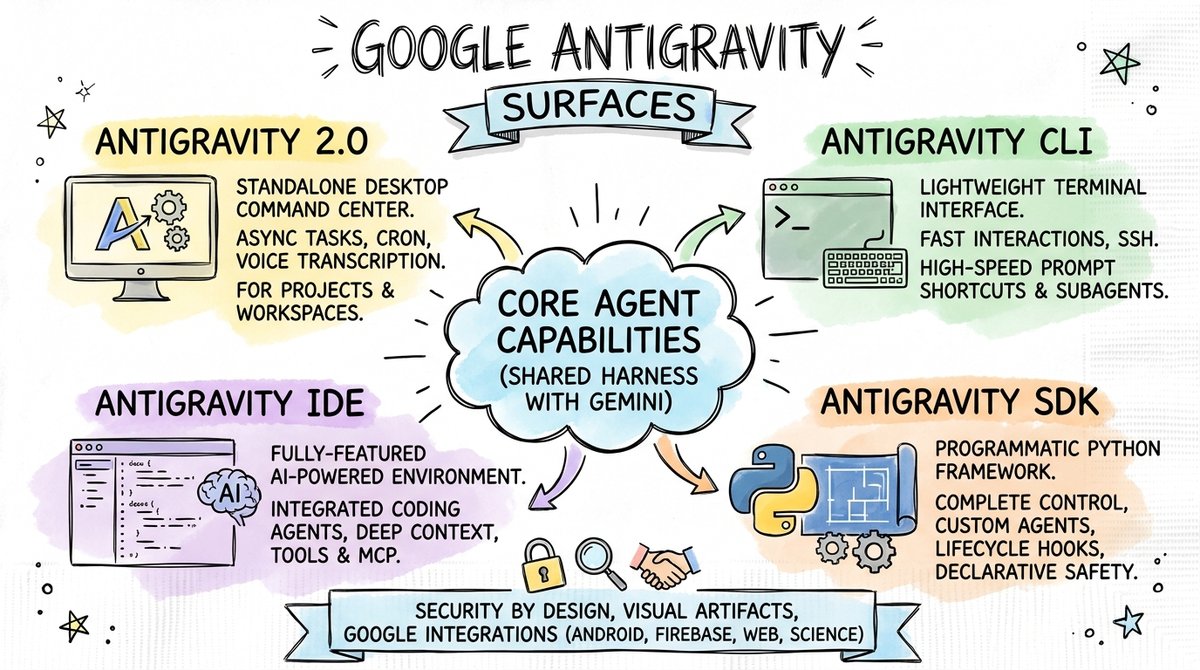
If you’re familiar with Antigravity, you’ll know it’s available across different surfaces:
- Antigravity 2.0: an agent manager for the Antigravity harness, where you can work across multiple projects and sessions from a rich UI,
- Antigravity CLI: a CLI coding agent, where you can interleave running terminal commands, with active agent coding actions,
- Antigravity IDE: a VSCode fork, with an integrated Antigravity chat assistant, when you want to be deep into the code,
- Antigravity SDK: which is actually a toolkit you can integrate and manage yourself, to create your own Antigravity harness.
Running Gemma 4 locally on Mac: Benchmarking Qxotic Jinfer, llama.cpp, MLX, and connecting Java 25 with LangChain4j
The benchmark numbers for Qxotic Jinfer in this article are outdated and abnormally low. At the time of testing, Jinfer had not yet been optimized for macOS and Apple Silicon processors.
Read more...