
Wiring ADK Kotlin agents in an Android application
With the launch of ADK for Kotlin, it means you can power up your Android applications with agents.
My colleague Jolanda Verhoef built an Android app that integrates an ADK agent written in Kotlin. It’s an app with a chat interface that lets you ask fun facts about anything you want.
You can check out the video of the Google I/O session that introduced ADK for Kotlin & Android, you’ll find another example agent in the demo near the end of the session.
Read more...Agentic Design Patterns
At Devoxx France 2026 and JNation 2026, I had the pleasure of presenting a session on Agentic Design Patterns. In this talk, I explore how to move beyond basic LLM wrappers to build reliable, scalable, and sophisticated AI agent systems.
In the coming weeks, I’ll be blogging about some of these patterns, that I implemented using LangChain4j and ADK for Java.
Abstract
It’s time to dive into the deep end, far from “hello world” demos. To build your multi-agent systems, you often start by assembling classic bricks: sequential or parallel flows, or loops. The basics!
Read more...
An ADK Java agent powered by Gemma 4
Today, DeepMind announced the release of Gemma 4, a very impressive and powerful new version of the Gemma family of models. As I’ve been contributing to ADK Java a fair bit recently, I was curious to see how I would configure ADK Java agents to work with Gemma 4.
In this article, we’ll explore 3 paths:
- Calling the AI Studio API surface directly,
- Calling Gemma 4 hosted via a vLLM instance thanks to the LangChain4j bridge.
- Calling Gemma 4 locally via Ollama
With the appropriate model weights format, we’ll also be able to run Gemma 4 locally via Ollama. But that’s for another day.
Read more...Building my Comic Trip agent with ADK Java 1.0
I’m happy to echo here the release of ADK for Java v1.0, Google’s Agent Development Kit framework to build AI agents in Java. I spent a lot of time on this project. I also wrote the announcement blog post on the Google for Developers blog. And I’ve recorded this YouTube video highlighting some of the new features of the framework, in which I’m demonstrating some of them via an app I built: my Comic Trip agent (pun intended).
Read more...A Javelit frontend for an ADK agent
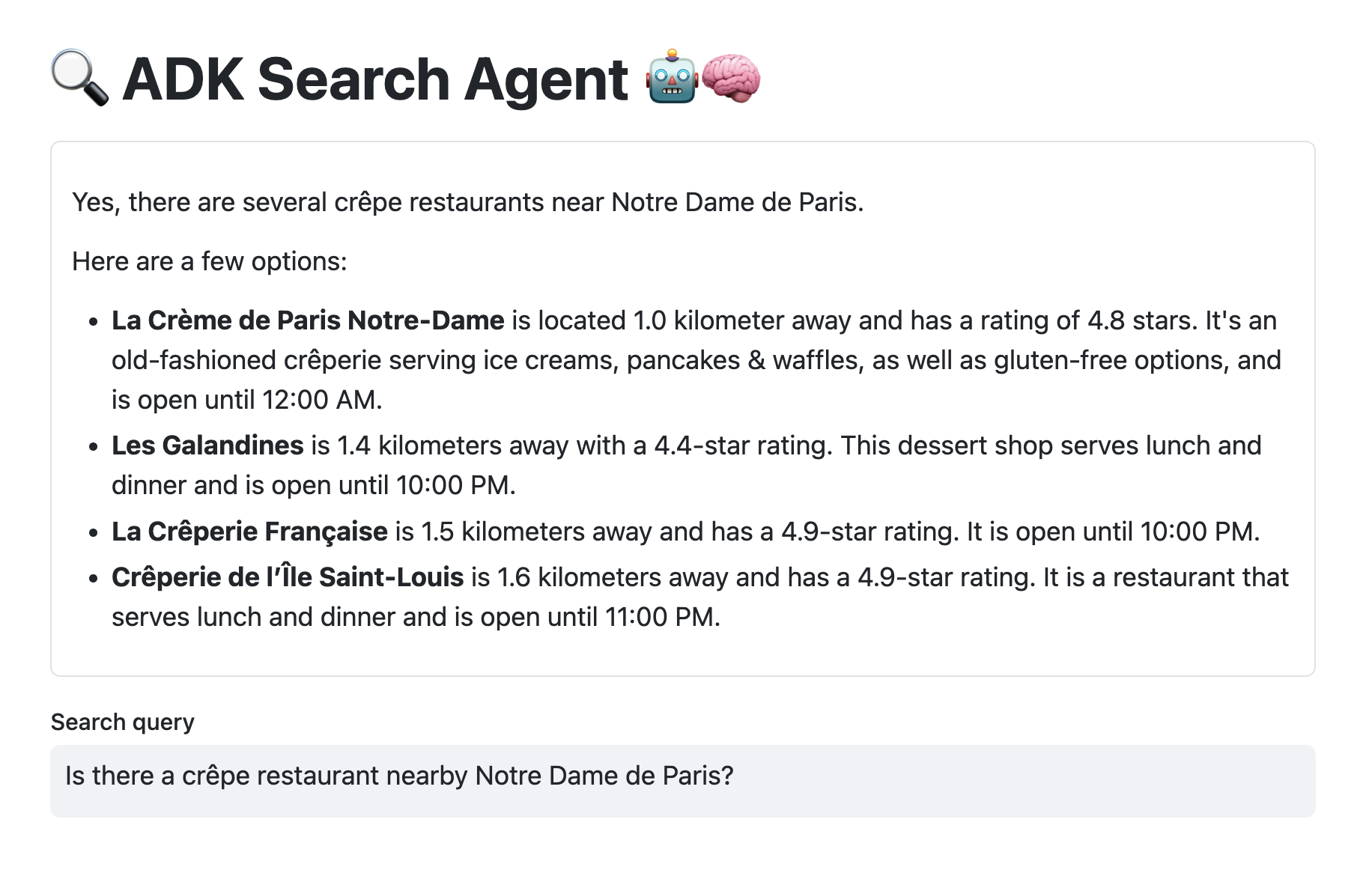
Continuing my journey with Javelit, after creating a frontend for “Nano Banana” to generate images and a chat interface for a LangChain4j-based Gemini chat model, I decided to see how I could integrate an ADK agent with a Javelit frontend.
The Javelit interface for an ADK search agent
Building AI Agents with ADK for Java
At Devoxx Belgium, I recently had the chance to present this new talk dedicated to ADK for Java, the open source Agent Development Kit framework developed by Google.
The presentation covered:
- an introduction to the notion of AI agents
- how to get started in a Java and Maven project
- how to create your first agent
- how to debug an agent via the Dev UI
- the coverage of the various tools (custom function tools, built-in tools like Google Search or code execution, an agent as tool, MCP tools)
- an overview of the different ways to combine agents into a multi-agent system: sub-agents, sequential agents, parallel agents, loop agents
- some details on the event loop and services (session and state management, artifacts, runner…)
- structured input / output schemas
- the various callbacks in the agent lifecycle
- the integration with LangChain4j (to give access to the plethora of LLMs supported by LangChain4j)
- the definition of agents via configuration in YAML
- the new long-term memory support
- the plugin system
- the new external code executors (via Docker containers or backed by Google Cloud Vertex AI)
- how to launch an agent with the Dev UI from JBang
Slides of the presentation
The slide deck of this session is embedded below:
Read more...Creative Java AI agents with ADK and Nano Banana 🍌
Large Language Models (LLMs) are all becoming “multimodal”. They can process text, but also other “modalities” in input, like pictures, videos, or audio files. But models that output more than just text are less common…
Recently, I wrote about my experiments with Nano Banana 🍌 (in Java), a Gemini chat model flavor that can create and edit images. This is pretty handy in particular for interactive creative tasks, like for example a marketing assistant that would help you design a new product, by describing it, by futher tweaking its look, by exposing it in different settings for marketing ads, etc.
Read more...Visualizing ADK multiagent systems
Let me share an interesting experiment I worked on to visualize your AI agent structure, more specifically, Agent Development Kit (ADK) multiagents.
The more complex your agents become, as you split tasks and spin off more specialized and focused sub-agents, the harder it is to see what your system is really made of, and how the interactions happen between the various components.
This is also something I experienced when I was covering Google Cloud Workflows: the more steps in the workflow, the more loops I had, indirections, conditions, etc, the trickier it was to understand and debug. And sometimes, as the saying goes, a picture is worth a thousand words. So when I was working on my recent series of articles on ADK agentic workflows (drawing diagrams by hand) this idea of experimenting with an ADK agent visualizer came up immediately.
Read more...Mastering agentic workflows with ADK: the recap
Over the past few articles, we’ve taken a deep dive into the powerful agentic workflow orchestration capabilities of the Agent Development Kit (ADK) for Java. We’ve seen how to build robust, specialized AI agents by moving beyond single, monolithic agents. We’ve explored how to structure our agents for:
- Part 1: Flexibility with sub-agents — Letting an orchestrator LLM decide the best course of action.
- Part 2: Order with sequential agents — Enforcing a strict, predictable execution path.
- Part 3: Efficiency with parallel agents — Running independent tasks concurrently to save time.
- Part 4: Refinement with loop agents — Creating iterative processes for self-correction and complex problem-solving.
In this final post, let’s bring it all together. We’ll summarize each pattern, clarify when to use one over the other, and show how their true power is unlocked when you start combining them.
Read more...Mastering agentic workflows with ADK: Loop agents
Welcome to the final installment of our series on mastering agentic workflows with the ADK for Java. We’ve covered a lot of ground:
- Part 1: Sub-agents for flexible, user-driven delegation.
- Part 2: Sequential agents for predictable, ordered processes.
- Part 3: Parallel agents for efficient, concurrent execution.
Now, we’ll explore a pattern that enables agents to mimic a fundamental human problem-solving technique: iteration.
For tasks that require refinement, trial-and-error, and self-correction, the ADK provides a LoopAgent.