
Agent eXperience (AX) in practice: Serving this Hugo blog as Markdown
Back in March 2025, I added llms.txt and llms-full.txt support to this blog.
The goal was to give Large Language Models a structured index of all my articles, plus a single consolidated file (llms-full.txt) that I could drop into Gemini’s large context window to ask questions across everything I had ever written.
Since then, the way developers and AI tools interact with web content has evolved quite a bit.
Instead of manually uploading a 700k-token file into a chat prompt, we now rely on autonomous coding agents (like Antigravity, Claude Code, GitHub Copilot, Cursor, or OpenCode) that browse the web and fetch individual documentation pages or blog posts on the fly.
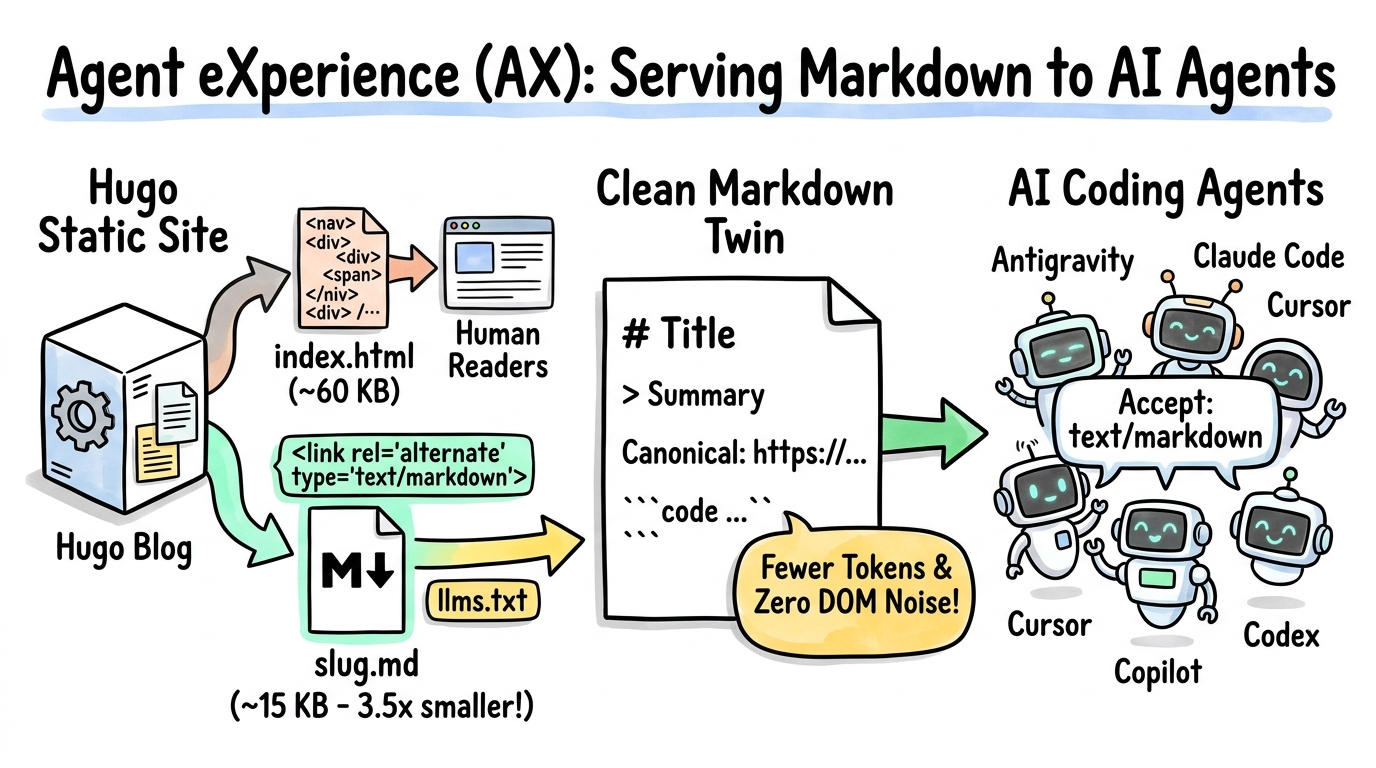
Today, I took another step to make this blog friendlier to those agents: every article now has a clean Markdown twin (.md), linked from the HTML header and from llms.txt.
You can view the Markdown version of this very article at agent-experience-in-practice-serving-this-hugo-blog-as-markdown.md, or inspect the updated site index at llms.txt.
The Rise of Agent eXperience (AX)
Before looking at the Hugo configuration, it is worth stepping back to look at the broader shift behind this change: Agent eXperience (AX).
In early 2025, Netlify CEO Mathias Biilmann coined the term Agent Experience to describe the holistic experience AI agents have as users of a product, platform, or website. In an interview with Richard MacManus on The New Stack (Beyond DX: Developers Must Now Learn Agent Experience (AX)), Biilmann noted that over a thousand sites were already being deployed to Netlify every day directly from ChatGPT and coding agents, requiring completely different authentication, handoff, and documentation flows than those built for humans alone.
Several recent articles have explored what AX means in practice for software teams and content creators:
- Agents: The new, New Kingmakers by Stephen O’Grady at RedMonk revisits his classic New Kingmakers thesis. A decade ago, developers became the decision-makers choosing which languages, libraries, and databases succeeded. Today, coding agents increasingly make those technology choices directly from a prompt (choosing frameworks, dependencies, and APIs on the developer’s behalf).
- What’s the Difference between Generative Engine Optimization (GEO) & Agent Experience (AX)? by Kate Holterhoff (also at RedMonk) draws a helpful boundary between marketing-driven GEO and engineering-driven AX: “GEO gets you mentioned. AX determines what happens next.” Getting cited in an AI summary is one thing; making sure an agent can actually read your docs or operate your tool without failing is another.
- Agent experience is the new developer experience by Alice Moore at Builder.io looks at AX inside codebases. Because coding agents are stateless, they need minimal, transparent context and deterministic verification loops rather than bloated prompts.
- Stop Getting Good at Protocols, Get Good at Agent Experience by Sean Roberts on O’Reilly Radar warns teams against chasing the “protocol of the month” (whether MCP, A2A, or skills) as a strategy in itself, instead of focusing on how reliably agents can discover, understand, and act on your services.
AX in Developer Relations
This shift hits particularly close to home for those of us working in Developer Relations. My friend Patrick Chanezon, who leads Developer Relations at Microsoft, wrote a thoughtful piece last November on Reinventing Developer Relations in the age of AI Agents. In it, Patrick outlined three dimensions for the evolution of DevRel:
- Helping developers transition from individual contributors to “managers of agents”.
- Transforming our own DevRel workflows with AI.
- Treating AI agents as a primary user persona of our developer services and documentation, which means investing in Agent Experience (AX).
As Patrick pointed out, you cannot improve what you do not measure. Just last week, he followed up with Measuring Agent Experience: open sourcing the platform we use, Project Scope, and an AX practitioner handbook, announcing the open-sourcing of Microsoft’s AX Practitioner Playbook and Scope, a Kubernetes-based evaluation harness to benchmark how coding agents perform multi-turn tasks across different harnesses, models, skills, and MCP servers.
Why llms.txt Alone Wasn’t Enough
In her RedMonk article on AX vs. GEO, Kate Holterhoff pointed out an uncomfortable truth about llms.txt: while it was proposed as a discovery standard, web server traffic analysis (such as the study by Evil Martians) showed that very few AI agents automatically probe /llms.txt on their own when asked to read a page.
In practice, when a developer pastes a blog post URL into Claude Code, Cursor, or Antigravity CLI (or when an agent follows a link from a search tool), the agent fetches that specific URL directly.
Until today, my /llms.txt file also linked to the HTML URLs of my posts.
When an agent fetched one of those URLs, it received the full HTML document: header menus, social links, sidebar widgets, lightbox markup, and tens of kilobytes of inline syntax-highlighting <span> tags generated by Hugo.
Two resources inspired me to fix this:
- acceptmarkdown.com, a guide and testing tool created by Ben Word that tracks which AI agents send
Accept: text/markdownheaders (currently supported by Claude Code, GitHub Copilot Chat and CLI, Cursor, OpenCode, and OpenClaw) or follow<link rel="alternate" type="text/markdown">tags (used by OpenAI’s Codex CLI). - Marko Denic’s article, How to Serve Markdown to AI Agents (and Why), which explains how to publish a
.mdtwin for every page and configure HTTP content negotiation.
How much difference does serving clean Markdown make on this blog?
Because Hugo’s syntax highlighter (noClasses = true) wraps every token of every code snippet in <span style="..."> tags, the HTML pages are much heavier than the underlying prose and code.
Here is the raw size comparison on five recent articles from this blog:
| Article | HTML (index.html) | Markdown (.md) | Reduction |
|---|---|---|---|
| The eMudhra CA Compromise | 69.1 KB | 23.5 KB | 2.9x |
| Crafting a Devoxx Schedule with Gemini | 57.0 KB | 16.8 KB | 3.4x |
| Gemini 3.8 Flash TTS with Java | 34.9 KB | 8.9 KB | 3.9x |
| The Unofficial Antigravity SDK for Java | 49.8 KB | 14.3 KB | 3.5x |
| Sharing a Git-Backed Obsidian Vault | 16.6 KB | 6.8 KB | 2.4x |
Beyond saving bytes and tokens, the agent gets clean fenced code blocks (```java) instead of nested HTML spans, with zero navigation clutter.
Generating Markdown Twins with Hugo
Since my blog content is already authored in Markdown with Hugo, and served via GitHub Pages, generating a clean .md twin at build time only took four small changes.
1. Enabling the markDown output format in config.toml
Hugo includes a built-in markDown output format with the text/markdown media type.
By default, Hugo outputs /posts/YYYY/MM/DD/slug/index.md.
I wanted the shorter /posts/YYYY/MM/DD/slug.md URL pattern (matching Marko Denic’s setup).
In Hugo, you can achieve this without changing your existing HTML URLs by enabling uglyURLs = true globally while setting noUgly = true on HTML and RSS, and noUgly = false on markDown:
uglyURLs = true

[outputFormats.HTML]
noUgly = true

[outputFormats.RSS]
noUgly = true

[outputFormats.llms]
baseName = "llms"
mediaType = "text/plain"
isPlainText = true
noUgly = true

[outputFormats.llms-full]
baseName = "llms-full"
mediaType = "text/plain"
isPlainText = true
noUgly = true

[outputFormats.markDown]
mediaType = "text/markdown"
isPlainText = true
noUgly = false

[outputs]
home = ["HTML", "RSS", "llms", "llms-full"]
page = ["HTML", "markDown"]
2. Creating the Markdown template (layouts/_default/single.md)
Instead of copying the raw source file with its YAML frontmatter, I created a single.md template in my theme (themes/glaforge-from-blank/layouts/_default/single.md).
Following Marko Denic’s recommendation, it starts with the article title, description, metadata (author, publication date, tags, and canonical URL), and then outputs the Markdown content while resolving Hugo’s internal {{< ref "..." >}} shortcodes into full URLs:
# {{ .Title }}
{{- with .Description }}

> {{ . }}
{{- end }}

Author: [{{ .Site.Params.author.name | default .Site.Title }}]({{ .Site.BaseURL }}) | Published: {{ .Date.Format "2006-01-02" }}{{ if and (not .Lastmod.IsZero) (ne (.Lastmod.Format "2006-01-02") (.Date.Format "2006-01-02")) }} | Updated: {{ .Lastmod.Format "2006-01-02" }}{{ end }}{{ with .Params.tags }} | Topics: {{ delimit . ", " }}{{ end }} | Canonical: {{ if .Params.canonical }}{{ .Params.canonical }}{{ else }}{{ .Permalink }}{{ end }}
{{ $content := .RawContent -}}
{{- $content = $content | replaceRE `\{\{<\s*ref\s+"/"\s*>\}\}` .Site.BaseURL -}}
{{- $content = $content | replaceRE `\{\{<\s*ref\s+"/?([^"]+?)(\.md)?"\s*>\}\}` (printf "%s$1/" .Site.BaseURL) }}
{{ $content }}
3. Advertising the Markdown version in <head>
For agents that fetch the HTML page first and look for a Markdown alternative (like OpenAI’s Codex CLI), I added a <link rel="alternate" type="text/markdown"> tag right below <link rel="canonical"> in layouts/_default/baseof.html:
<link rel="canonical" href="{{ if .Params.canonical }}{{ .Params.canonical }}{{ else }}{{ .Permalink }}{{ end }}">
{{ with .OutputFormats.Get "markDown" -}}
	{{ printf `<link rel="%s" type="%s" href="%s" title="%s (Markdown)">` .Rel .MediaType.Type .Permalink $.Title | safeHTML }}
{{- end }}
4. Pointing llms.txt directly to the .md files
Finally, I updated layouts/_default/index.llms.txt so that /llms.txt links to the .md twin of each article rather than the HTML page:
{{ range .Pages }}
{{- $url := .Permalink -}}
{{- with .OutputFormats.Get "markDown" -}}{{- $url = .Permalink -}}{{- end }}
- [{{- .Title -}}]({{- $url -}})
{{- end -}}
The Limitations of Static Hosting on GitHub Pages
While this static Hugo setup gets us a long way, hosting on GitHub Pages comes with a few HTTP-level limitations that are worth calling out.
First, the good news: when Hugo builds the .md files and deploys them via GitHub Actions, GitHub Pages serves them with the proper RFC 7763 MIME type and UTF-8 charset parameter out of the box:
HTTP/2 200
server: GitHub.com
content-type: text/markdown; charset=utf-8
However, because GitHub Pages is a purely static file host with no custom server configuration or header rules, two pieces from acceptmarkdown.com and Marko Denic’s post are not possible on GitHub Pages alone:
- No HTTP Content Negotiation (
Accept: text/markdown) on canonical URLs: When an agent like Claude Code or Cursor requestshttps://glaforge.dev/posts/2026/10/30/agent-experience-in-practice-serving-this-hugo-blog-as-markdown/withAccept: text/markdown, GitHub Pages cannot dynamically rewrite that request to serveagent-experience-in-practice-serving-this-hugo-blog-as-markdown.md. It will still returnindex.html(text/html). To get the Markdown version, the agent (or user) either needs to follow the<link rel="alternate" type="text/markdown">tag in<head>, follow the link from/llms.txt, or append.mdto the URL (stripping the trailing slash). - No custom HTTP response headers (
Link,Vary,Cache-Control): GitHub Pages does not support_headersfiles. We cannot attach aLink: <...>; rel="canonical"HTTP response header to the.mdfiles, nor setVary: AcceptorCache-Control: private. Including theCanonical:URL at the top of the Markdown text helps agents identify the canonical source, even without the HTTPLinkheader.
If you want full Accept: text/markdown content negotiation and custom HTTP headers in front of GitHub Pages, the easiest option is to put your domain behind Cloudflare (either using a small Cloudflare Worker to route Accept: text/markdown requests to the .md file and set the Vary and Link headers, or enabling Cloudflare’s Markdown for Agents feature) or to host on a platform that supports header-based rewrites like Netlify or Vercel.
Wrap-up
Adapting a static blog to serve clean Markdown twins is a small, thirty-minute tweak in Hugo, and a practical step toward better Agent eXperience (AX).
Whether an agent discovers my articles through /llms.txt, inspects <link rel="alternate" type="text/markdown"> in the HTML header, or fetches a .md URL directly, it can now read the prose and code snippets without wading through HTML layout noise.